What Is a Coworking Space? A Guide for Businesses in Norway

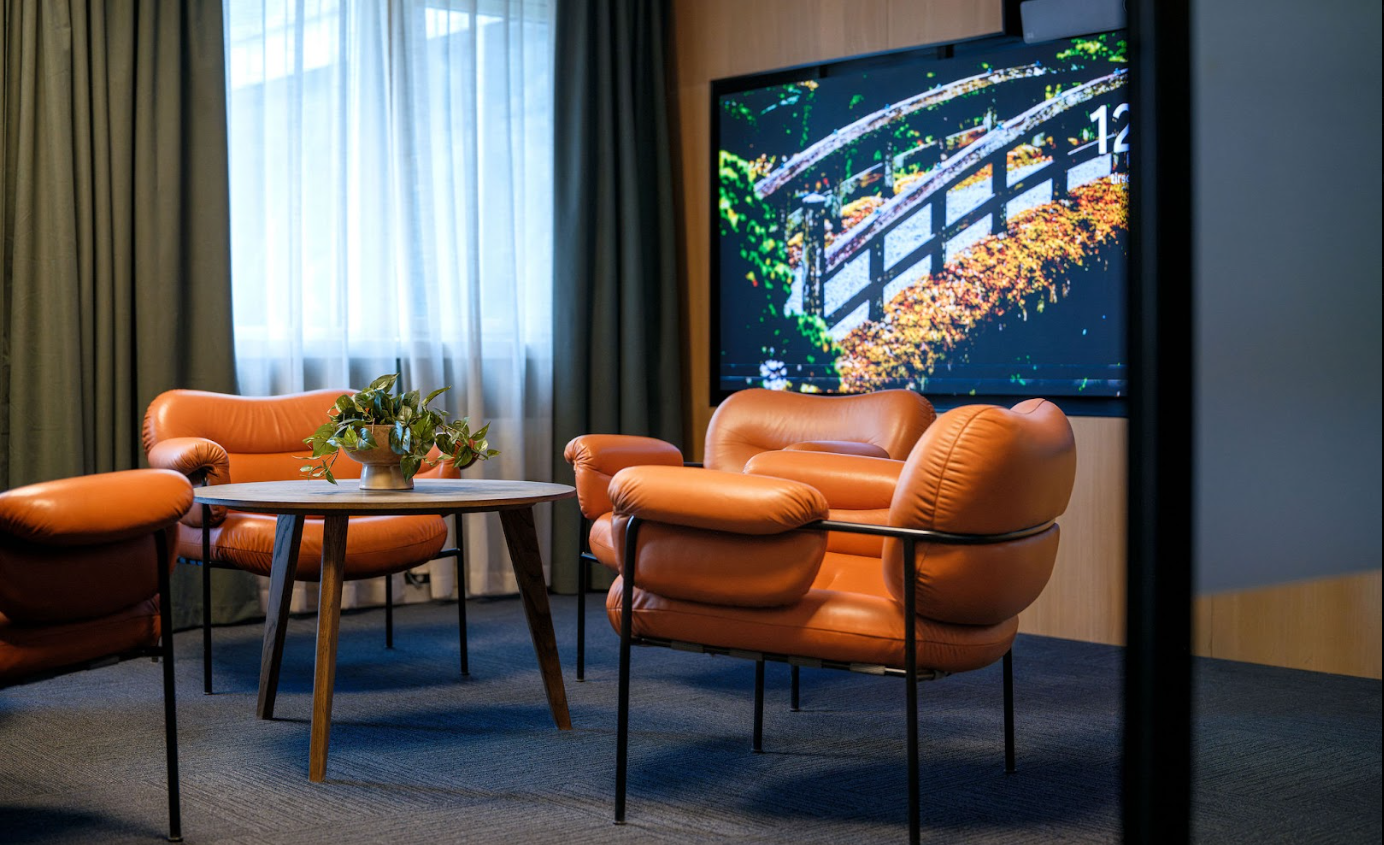
More and more Norwegian businesses are asking the same question: do we really need an office of our own, or is there a smarter way to work? A coworking space is one answer that has grown quickly in recent years. Instead of committing to a long lease and running everything yourself, your company shares premises, facilities and a community with other companies. In this guide we go through what a coworking space actually is, what it includes, and how to assess whether it suits your business. We also look at how coworking differs from a traditional office and from an all-inclusive workspace, so you can make an informed decision.
What is a coworking space, really?
A coworking space is a shared work environment where several companies and individuals work under one roof, with access to shared facilities such as meeting_room, a kitchen, internet and social areas. You can rent office space for one person or for an entire team, often with far more flexibility than a traditional lease allows. The point is simple: you get a complete workplace without having to build and run it yourself.
A good shared office is about more than square metres, though. It is about the people around you. At FOMO in Forus, more than 200 companies share the same campus, and your neighbour can just as easily become your next customer or partner as someone you simply greet in the lift.
What sets coworking apart from a traditional office?
In a traditional office you rent an area, sign a long contract, and are responsible yourself for furniture, internet, cleaning, reception and all the practical details. In a coworking space this is already sorted. You move into ready-made all-inclusive office solutions and pay for what you actually use. For many companies that means lower risk, a faster start, and easier scaling when the team grows or shrinks.
What is included in a coworking space?
What is included varies from provider to provider, but a good coworking space brings together everything a team needs for a productive workday. At FOMO this is part of the experience, not add-ons you have to remember.
Typically you get a furnished, modern workplace, high-speed internet, access to meeting rooms, a kitchen with coffee, social areas, reception and cleaning. At FOMO you also get access to meeting and conference rooms in many sizes, a 400 m² gym, dining through Soi21, and more than 550 parking spaces on campus. Together this lets the team spend time on the work, not on the operations around it.
The value lies not only in the facilities themselves, but in someone else running them. When internet, cleaning, reception and meeting rooms simply work, the team avoids spending time on things that are not the core business. For a small company, that can be the difference between an employee spending half the week on practical matters, or being able to focus on the customers. This is often where the real benefit of a shared office lies.
Coworking, all-inclusive office or enterprise office?
Coworking is one point on a scale. At one end you have the most flexible membership model, where you rent office space in an open community. At the other end you have a private enterprise office, where the company gets its own defined area on a traditional lease, but still with a world-class campus around it.
In between sits the all-inclusive workspace. Here the company gets its own private offices, but without having to think about operations, furniture or facilities, because everything is included in one predictable price. For growing companies this is often the best balance between privacy, flexibility and simplicity. In short: coworking gives maximum flexibility, the enterprise office gives maximum control, and the all-inclusive solution gives a bit of both.
Why do Norwegian businesses choose coworking?
The way we work has changed. Hybrid work has become the norm for many, and that affects how much and what kind of office a company needs. Figures from Statistics Norway show that 45 percent of employed people in Norway had the option to work from home in 2024, while 7 percent worked from home half the time or more. When the team is in the office only a few days a week, it makes little sense to pay for a large, empty space the rest of the time.
A coworking space solves this by giving flexible space and a strong professional community at the same time. Location matters too. Forus is Norway's largest business area, with 3,000 companies and 46,000 employees gathered in one place. Having a modern workplace in the middle of this environment gives proximity to customers, partners and talent that is hard to achieve any other way.
In addition, a shared workplace gives more predictable costs. Instead of a long list of separate bills for electricity, cleaning, operations and furniture, much is gathered into one price. For a company planning a budget, it is easier to deal with one predictable sum than with many variable items that fluctuate from month to month.
Is a coworking space right for your business?
Coworking suits a wide range, but not everyone the same way. For freelancers and founders it offers a professional environment and a network from day one, without large fixed costs. For startups and growing teams it offers the ability to scale up or down without changing address every time the headcount shifts. Established companies choose coworking too, whether for an entire team or for a satellite office in a new region.
The most important consideration is what kind of daily life you want to give your team. If it is only about a desk, cheaper options exist. If it is about an environment where people thrive, perform and meet other ambitious companies, a coworking space is often worth every krone.
FAQs
What does a coworking space cost in Norway?
The price varies with city, location and how much you need. A single desk in an open community costs less than a private office for the whole team. Because many services are included, such as internet, meeting rooms, cleaning and coffee, the total cost is often more predictable than with a traditional lease, where such expenses come on top. Always ask for a single monthly price, so you can see what is actually included.
What is the difference between a coworking space and shared office?
In practice the terms are used interchangeably. Shared office is the everyday Norwegian word for the same thing, a shared work environment with common facilities. Coworking space is the international term that has stuck, especially among companies with international staff. Whatever you call it, the core is the same: several companies share premises, services and a community.
Does coworking suit larger companies?
Yes. Many think coworking is only for freelancers and small teams, but more and more larger companies choose this model for entire departments or regional offices. At FOMO there are solutions from a single desk to a fully private enterprise office, so a company can start small and grow within the same campus without having to move.
In short
A coworking space gives your business a complete, modern workplace without the burden of running it yourself, combined with a community that can open doors. For Norwegian companies looking for flexibility, predictable costs and a strong professional environment, it is an option worth considering seriously. The key is to choose a provider and a model that suits the way your team actually works.
Want to see what this looks like in practice? Get to know the community of more than 200 companies at FOMO, and find a workplace your team actually looks forward to coming to.
 NO
 EN