Business Strategy
FOMO Works AS in the period following the Covid-19 pandemic · 25.03.2020

FOMO Works in the time after the Covid-19 pandemic
INTRODUCTION
The Covid-19 pandemic has affected, and will without exception continue to affect, the global economy. In this extract we set out the strategies we as a group have worked to since our establishment in the summer of 2019, and how we view our business opportunities going forward. This is not the first time we have been through a recession, and we have good experience of the strategic choices our customers will make in the time ahead, and of how we should position ourselves to maintain the "unfair" competitive advantages we have established through the FOMO concept since the start.
On 24 May 2019 we wrote the following in our business strategy:
“Collaboration is a central part of people's everyday lives and their ability to survive. Yet ever since the industrial revolution, business has placed people in rows to perform individual tasks. The world's leading companies broke this pattern long ago, and applaud interaction, collective thinking and creativity over individualism, coercion and control.
It is no longer a question of if, but when the traditional way of organising an office is also completely outdated. We believe the time is now. That is why we will develop one of the world's largest coworking spaces and meet the human needs for inclusion and belonging.
FOMO will put the employees at the centre. Already now we see trends showing that employees increasingly determine the geographical location of companies. We will strive to make the working day simple, exciting and fun. We do not care about the established. We create 'spaces' where the young talent of today and tomorrow want to work."
What we will see the effect of after the corona pandemic is that companies with young talent and a culture that challenges established thinking will do excellently and emerge as the new winners in the market. The established business models, on the other hand, will meet strong headwinds, and many will probably disappear.
Our positioning in this "new" market could not have been better timed. While competitors now have to dump their prices (in an already poor market), we can operate as before, because the customers' decision criteria going forward will shift from a one-sided price focus to what gives the best strategic advantages overall.
THE STRATEGIC CHOICES FACING OUR CUSTOMERS
When the market stabilises again (probably after the summer), the cards will have been dealt anew. For the players who made it through the crisis, the growth opportunities will be many, and the players who before the crisis kept prices at an artificially low level (regardless of the market) are traditionally the first to go under in hard times, because of low margins and low solidity. Players with quality solutions, good customer relationships and solid finances generally make it through crises. If we read the market correctly, these companies are now laying plans for how to take over positions in the market.
In uncertain times, and when the economy is under heavy pressure, there are certain central measures that recur for most companies. We will link the strategic choices we have made before and after the crisis to these four points:
- sales, network building and customer contact
- focus on lower costs
- streamlining of work processes and employees
- predictability and flexibility in contracts
FOMO'S STRATEGIC CHOICES BEFORE COVID-19
As mentioned, we have felt at first hand how the market in our region can change overnight because of extreme exposure to the oil price. That is why, since the establishment of FOMO, we have made a number of strategic choices to position the company to meet the new global trends and threats.
The most important decision that was taken was to focus sales towards technology companies without large exposure to oil and gas. 92% of our portfolio is not directly exposed to oil and gas. This makes us better equipped to withstand a fall in the oil price. The tenants often sell into a larger international market, so when the krone exchange rate falls, this gives them better profitability.
A high concentration of technology companies also works as a magnet on other companies in the same industry. This has proved to hold true very well, as we were able to stop cold sales just two months after opening because of all the references we received from companies that had moved in.
Another central measure to reduce risk has been to write a 1-year lock-in period + 3 months' notice for all coworking lease agreements. That means most of the leases run until the spring of 2021.
In addition, we have made the following choices to meet the tenants directly on their decision criteria for office location:
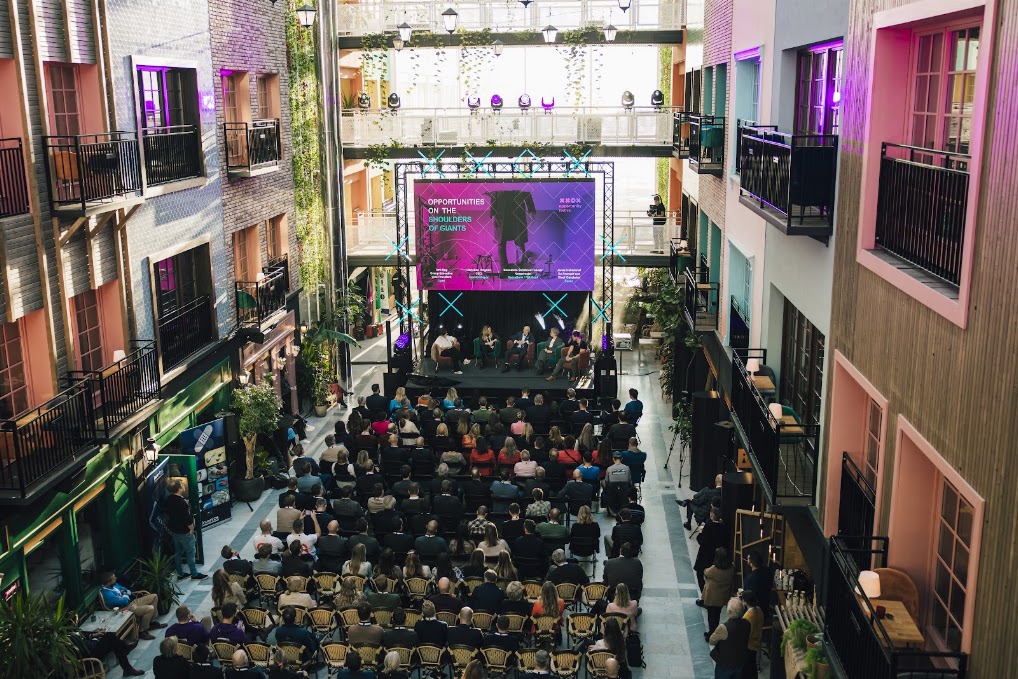
- To meet the customers' need for sales networks and customer contact, the atrium was defined early on as "The new meeting place for business on Forus". We did this deliberately, as none of the competitors had "taken" this position, and the business community on Forus was asking for such an arena (ref. the Forus meeting, spring 2019). In the weeks before the country was shut down, we had orders worth several hundred thousand for conferences, and enquiries were pouring in from companies such as Ernst & Young AS, Færder Energi, Aker BP, Equinor, Choice, Forus Næringspark A/S, Corporater, ASKO, Bi Builders, Regnskapshuset SR, Couldway, DNB, Proplan, Emerson Automation Solutions and so on.
- Most companies have a conscious relationship with their operating costs, and this often governs the choice of office — but not always:
- In times of growth, the office location often becomes a central factor in attracting and retaining key personnel. It is extremely costly to train up staff, and those who understand this choose office solutions that motivate employees to stay with, or join, the company.
- By offering all the operating services as a package for those in the coworking space, we reduce both risk and workload for the tenants. For companies with fewer than 10 employees that are growing, this is an extremely favourable model, which gives the business the peace to focus on core tasks such as sales and development.
- A clear dialogue about establishing exclusive office areas when companies grow out of the coworking space has also given the tenants a reassurance that we are always working to offer them the most cost-efficient model.
- The way we design the office premises and the shared areas is carefully planned on the basis of experience and insight into attractive office environments, health effects and impact on work efficiency. Among other things, it is scientifically proven that extensive use of plants gives lower sickness absence and higher work efficiency — perhaps the two most important parameters in a high-cost country such as Norway.
After 4 months of operation we can now see the effect of this through almost 10 million NOK in signed lease agreements, where several of the tenants have stated that the choice stood between FOMO, as the only alternative on Forus, and the city centre.
- Predictability and flexibility in contracts is also a central sales trigger at FOMO, which offers 3 months' notice for coworking space members. In good times, tenants ask for predictability with regard to scaling the office area in line with the company's growth, and in bad times they want flexibility and the possibility of reducing the area they use. In other words, our model is the most preferred one whichever way the market goes.
FOMO'S STRATEGIC CHOICES AFTER COVID-19
We are continuing as planned and using the days painstakingly to plan for exponential growth in all activity towards the autumn. One of the central instruments that has previously been used in the period after times of crisis is to gather in order to exchange experience, build networks, establish new sales channels and stimulate technology companies (ref. public support schemes).
While others wait for better times, we will continue to build unique competitive advantages that are almost impossible to copy in a tough property market. In innovation theory this is called an "unfair competitive advantage".
Here are some examples:
- We are building a gathering place for the business community through extensive use of exciting meeting rooms that stimulate interaction and creativity, as well as a striking atrium open to the public.
- A lunch venue for the business community, centrally located in the middle of Forus.
- A food court that meets a large need for more places to eat in the area.
- A top-equipped fitness centre set up for CrossFit, strength, conditioning and yoga, aimed at the millennial generation (the most important group for kick-starting change and building new business models).
- A dedicated area set up for health personnel such as chiropractors, physiotherapists, masseurs and personal trainers.
- Norway's largest escape room, with as many as 9 different rooms/themes.
- A 50 sqm LED advertising screen facing the E39 for promoting tenants.
- Extremely good visibility on social media (today reaching up to 20,000 per post on LinkedIn).
In other words, our most important customer promise is not the offices themselves: it is the sum of the content that creates enthusiasm and makes people choose FOMO over traditional office buildings.
THE STRATEGIC CHOICES FACING OUR COMPETITORS
We are going to see many property owners dump prices even further than before the crisis, and competitors who disappear entirely. This is in no way a concern for us, for the following reasons:
- When the portfolio weakens, they make poor choices and reduce their own ability to compete through lower earnings and less room for manoeuvre.
- They take fewer chances and are unlikely to enter into direct competition with the offering we are building at FOMO.
- Historically they retreat to safe solutions and will fight tooth and nail for long contracts from large businesses in oil and gas. This only makes them even more vulnerable when the arrows point downwards.
- Some players try their hand at coworking, but it requires a particular insight into how to build inclusive arenas around the people who sit in the environment. Historically, few players have succeeded in this market.
 NO
NO  EN
EN