The numbers behind Forus
Few places in Norway concentrate this much expertise, capital and momentum into so little ground. Forus is one of them. If you're deciding where your business should sit for the next decade, start here.
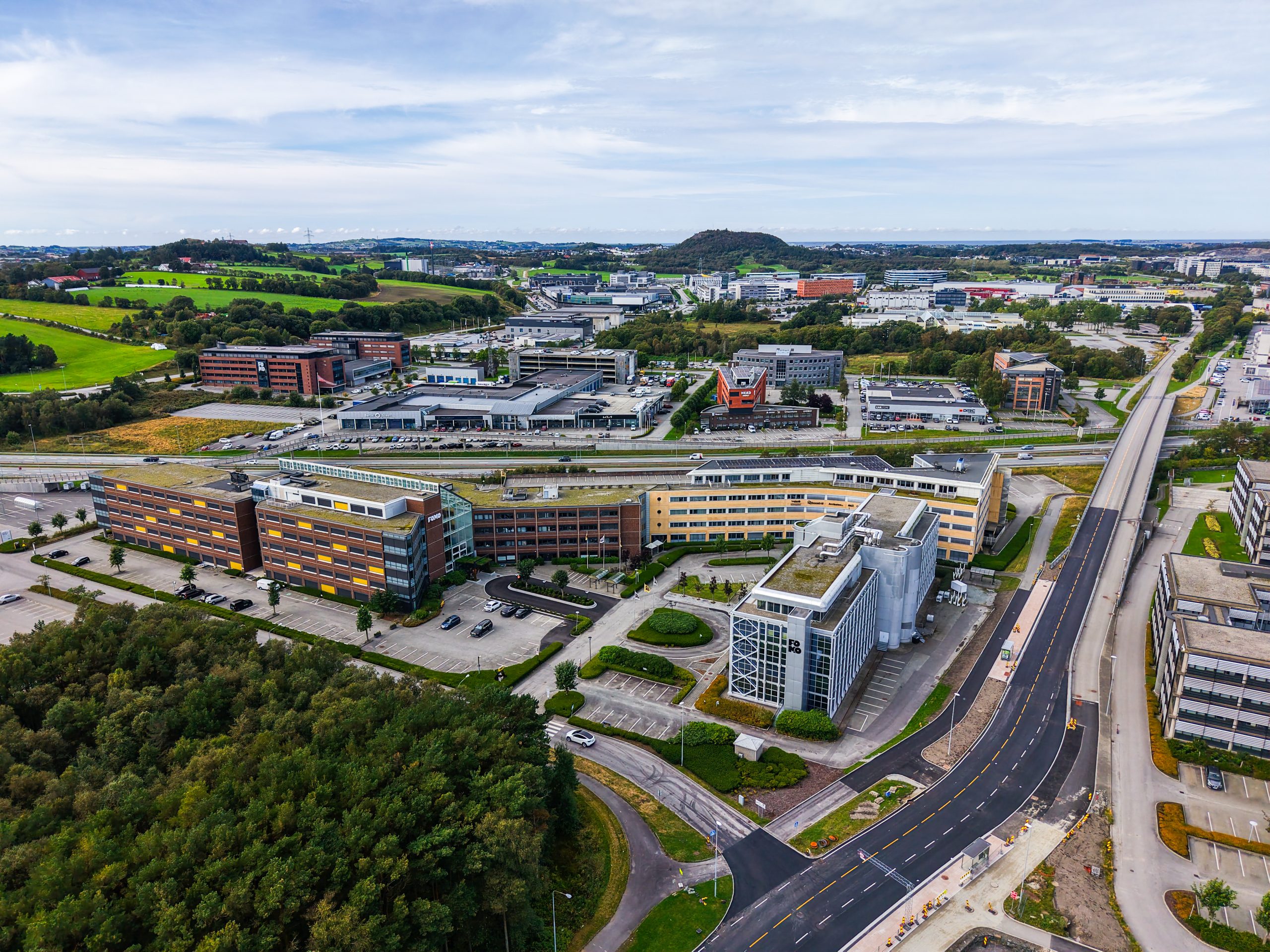
THE NUMBERS BEHIND FORUS
Forus straddles the municipal borders of Stavanger, Sandnes and Sola. The area holds more than 6.5 million square metres of commercial property, around 3,000 companies and roughly 46,000 employees. Together they account for a fifth of Norway's total value creation.
A report from the research institute NORCE, covered on forus.no, puts the trajectory in perspective. In 1984, Forus was home to 95 companies with 3,300 employees between them. By the end of 2023 the number of companies had reached nearly 2,900. Value creation over the same period grew from 40 billion to 1,650 billion NOK.
For scale: the workforce on Forus matches the combined workforce of the municipalities of Klepp, Time, Hå, Gjesdal, Strand and Hjelmeland.
44 per cent of employees work in energy-related businesses. Business services account for 23 per cent, retail for 14. That makes Forus considerably more than an oil cluster. It's a complete commercial ecosystem, with customers, suppliers, talent and capital within walking distance of each other.
And it's still growing. According to Forus Næringspark the number of jobs has doubled since 2001, and the area has capacity for 100,000.
INFRASTRUCTURE IS THE REAL ADVANTAGE
Plenty of business districts have good numbers. Few have the infrastructure to match.
Car. Forus sits on the E39 motorway with direct access from several directions. The road network was built for commercial traffic. Stavanger city centre, Sandnes city centre and Stavanger Airport Sola are all under 15 minutes away.
Bus. Forus is the public transport hub of the Nord-Jæren region. Bussveien, the region's bus rapid transit system, runs through the area on its own dedicated lanes, independent of the traffic beside it. From here you reach the rest of the region with at most one change.
Train. Gausel station is four stops away on Bussveien. If you live in Egersund, Bryne or central Stavanger, you take the train to Gausel and arrive at Forus five minutes later.
Bicycle. The regional cycle highway runs through the area, connecting Stavanger, Forus and Sandnes on one continuous route.
Air. Stavanger Airport Sola is fifteen minutes away. For companies with international operations or frequent client visits, this is one of the strongest arguments anywhere in the region.
Each of these is strong on its own. The advantage lies in all of them being strong at once. Wherever your people live across Nord-Jæren, and however they prefer to travel, Forus works.
That's a recruitment advantage. Commute is one of the things people genuinely weigh when they change jobs.
BUILDINGS THAT HOLD THEIR STANDARD
Commercial property on Forus has been through significant upgrading over the past decade. Large volumes of space have been fully renovated with modern technical systems, low energy consumption and flexible layouts.
High standard, generous floor space and ample parking is a combination that's hard to come by in a city centre. On Forus it's the norm rather than the exception.
FOMO SITS AT THE CENTRE OF IT
FOMO is located on Grenseveien, in the middle of Forus. The quarter consists of six buildings totalling 34,000 m², fully renovated between 2020 and 2023.
Here's what access looks like for the roughly 200 companies based here:
- 800 parking spaces across the campus, 550 of them at Grenseveien, with EV charging
- A bus stop outside the door, with 14 direct routes and departures every 3 minutes at peak hours
- The cycle highway runs across the site, with large indoor bike parking and a service station
- Gausel station four stops away on Bussveien – around five minutes
- Stavanger Airport Sola fifteen minutes by car
Energy consumption sits at 85 kWh/m², covered by a large solar installation and district heating. That keeps shared costs low for tenants.
When Equinor occupied Grenseveien, the building recorded the lowest sick leave of any of their locations.
FROM BUSINESS PARK TO DESTINATION
For a long time, Forus was somewhere people drove to in the morning and away from in the afternoon. That's changing.
With 23,000 residents alongside the 46,000 who work here, the area has taken on genuinely urban qualities: restaurants, retail, gyms and things to do. Forus is becoming a place where people live, work and spend their time.
That shift is exactly what FOMO was built to accelerate. The Soi21 staff restaurant, a café and bar, 15 meeting and conference rooms, 400 m² of training facilities and a community of nearly 200 companies. All on the same campus.
We call it Love Where You Work. It describes what it actually takes for people to enjoy a place enough to stay.
IS THERE A BETTER PLACE TO BUILD A BUSINESS?
We're biased, obviously. But the arithmetic is simple.
You get proximity to customers and suppliers in Norway's densest business cluster. You get employees who can reach the office regardless of where they live or how they travel. You get modern buildings at a rate no city centre can offer. And you get fifteen minutes to the airport.
If you're building something ambitious, build it somewhere that's already ambitious.
WANT TO SEE IT FOR YOURSELF?
Book a tour of FOMO →
Read more about all-inclusive office solutions and enterprise office space at FOMO.
Sources: Forus Næringspark – About Forus and Milliardene ruller på Forus (NORCE report, published 12 September 2024).
 NO
NO  EN
EN